
The Arrest
Three young Norwegian women were arrested in Bolivia. Each carried seven kilos of cocaine in Adidas bags. What followed ignited a media storm in Norway. They became names. Faces. A spectacle. They were sent to San Sebastián prison... And then their stories changed.
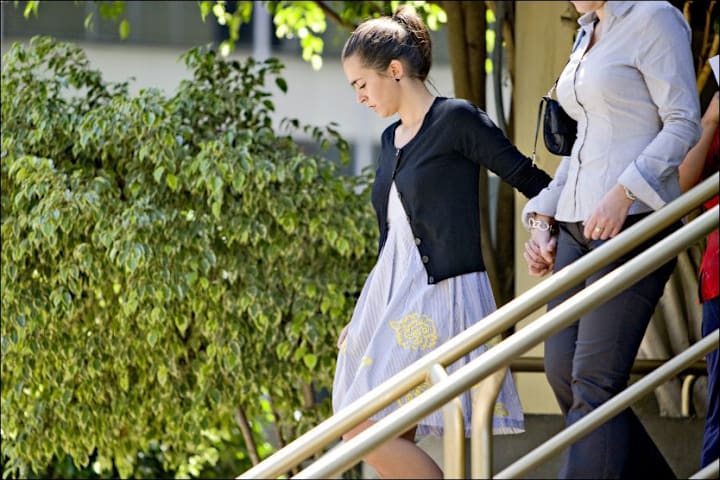
Christina Øygarden
Escaped — with the help of her father and Norwegian authorities.

Stina Brendemo
Escaped — with the involvement of journalists from Alfa Male Magazine, and mercenaries.

Madelaine Rodriguez
Was left behind.
Eighteen years later, she is still not allowed to leave Bolivia.
Three Norwegian friends were stopped at the airport in Cochabamba carrying 21 kilos of cocaine.
Headlines in Norway called it "the biggest drug bust."
They were sent to San Sebastián Prison.
Then Norway arrived: families, cameras, tabloids.
Norwegian paparazzi followed them into the courtroom.
The case became entertainment before it became history.
From here, their stories separate.
The Case

The film follows the case across borders—Bolivia and Norway—and across years.
It traces how three women and five others connected to the case were pulled into a machine made of courts, consulates, prisons, media deals, political pressure, and public hunger.
Subject and themes:
Why were some able to escape and others not?
Why is punishment concentrated on the person left behind?
Why did Norwegian media and institutions shape the outcomes?
Why does "justice" change depending on who is speaking and from where?
Voices from the case:
Documentary / TV Series
In December 2025, TV2 in Norway released a dramatised series about the Bolivia cocaine case. The series reignited public interest, raising many unanswered questions.
The Bolivian Case documentary first premiered in 2015, offering an unvarnished record of events, institutional accountability and questions that made this story too uncomfortable for Norwegian broadcasters.
The film was commissioned by NRK, with Bolivian director Violeta Ayala's perspective stated as a priority. During the editorial process, NRK pushed to remove material examining the Norwegian government's role in issuing a passport under a new identity to one of the women—enabling her illegal escape from Bolivia. The film was effectively blocked from Norwegian broadcast while continuing to screen internationally.
Why this film matters now

Madelaine Rodriguez remains trapped without closure, unable to return home to see her daughter and family.
Her family is still fighting for justice.
Stories don't end when the cameras stop.
Justice moves differently depending on where you stand.
Some people are allowed to disappear, others are required to remain visible forever.
It shows how power, media and justice intersect — and how those forces determined who would be declared innocent and who would be presented as guilty, who could leave and who would remain to face the consequences.

Selected Festivals & Awards

Selected Reviews
"Instead of asking us to question the guilt or innocence of these women, Ayala asks us to confront how gender—and also race and class—affects how we assign guilt."
"An eye-opening criminal exposé."
"Very entertaining… jaw-dropping… a film you couldn't write as fiction."
"This is reality TV meets true crime in a grand criminal exposé that sheds light on modern crime and punishment."
"A cleverly constructed piece of cinema… it lures its audience in with a promise of suspense-thriller, but refuses to stay as popcorn entertainment."
"The most notable film of 2015… a brave film that follows the thematic line of its creator: the drug war."
"The best of 2015… one of the most gifted investigative filmmakers of our time."
Watch the documentary
The Bolivian Case is a feature-length documentary filmed from 2010 to 2014 — from imprisonment, to escape, to the Norwegian verdict.
If you want to understand what the series could not show, this is where that story lives.
▶ Watch the filmAvailable in English and Spanish (Español)